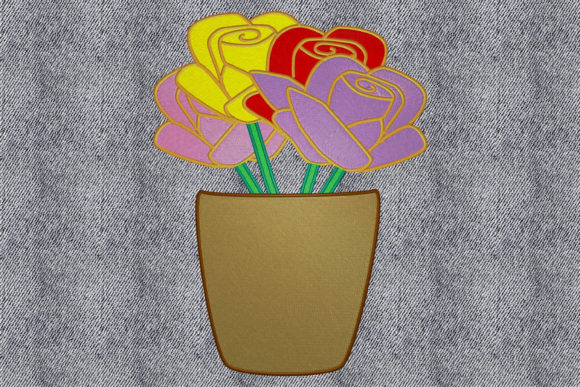
Pot with Flowers Embroidery Design
First Impression: Fresh, Friendly, and Fair-Ready
“Pot with Flowers” lands exactly where it should — warm, approachable, and quietly confident. It’s not fussy or overly botanical; it’s a clean, balanced bouquet-in-a-pot motif that reads as both modern cottagecore and timeless handmade. No cartoonish stems, no overwhelming foliage — just a grounded pot holding a soft, layered arrangement. That makes it instantly legible at craft fair distance: customers scanning your booth table will lock onto it before they even slow down. It feels like a small moment of calm — perfect for shoppers seeking handmade charm without kitsch.
Where Pot with Flowers Shines on Craft Fair Products
This design flexes beautifully across your most reliable handmade product categories. On a natural canvas tote bag? It’s a subtle signature — elegant but not precious. On a linen apron? It adds artisanal warmth right over the pocket, reinforcing “made with care.” For tea towel embroidery, Pot with Flowers works best centered near the hem — the vertical flow of stems and leaves echoes the towel’s drape, and the pot anchors the composition so it doesn’t float.
As an embroidered patch, Pot with Flowers holds up remarkably well — its defined pot base gives structure, and the flower cluster stays cohesive even at 3" wide. That makes it ideal for iron-on or sew-on patches sold separately or pre-applied to pouches and caps. Speaking of caps: place it on the front panel (not curved crown) for clarity — the pot’s straight edges help it read cleanly against stitching lines.
Pillow covers are where Pot with Flowers becomes a quiet hero. At 5–6" wide, it reads as intentional, refined, and giftable — especially on oatmeal, sage, or dusty rose linen. And for small shop products like fabric pouches or market bags? It scales down gracefully as a focal accent — never lost, never cramped.
What Makes It Sell — and What Makes It Stick
Customers don’t buy “embroidery.” They buy feeling — nostalgia, calm, intention, personality. Pot with Flowers delivers that in under three seconds. It signals craftsmanship without shouting. That’s gold for Etsy sellers and boutique makers building brand consistency: it fits seamlessly into a curated line of nature-inspired, neutral-toned handmade goods. It also photographs exceptionally well — soft shadows under the pot, gentle texture in petals, clear contrast between pot and blooms. That means stronger printable mockups, more engaging Instagram posts, and higher click-through on digital listings.
Crucially, it’s repeatable. You can stitch Pot with Flowers across 20 pillow covers or 50 tea towels with consistent visual impact — no complex repositioning, no finicky alignment. As a machine embroidery design, its rhythm is steady: moderate stitch density, no extreme fill transitions, and generous spacing between elements. That translates to fewer thread breaks, less rehooping, and smoother batch production.
Design Assets That Support Real-World Use
- Multipurpose file formats mean you’re not locked into one machine — essential when juggling home embroidery for samples and commercial machines for bulk orders.
- The Bouquets category placement is smart: it groups Pot with Flowers with other emotionally resonant floral motifs, helping buyers discover it alongside complementary designs for coordinated collections.
- Its simplicity makes it easy to pair — think monochrome thread on natural fabric, or contrasting ecru thread on indigo denim. That versatility expands your color storytelling without extra design work.
Careful-Use Notes Every Embroidery Designer Should Check
Pot with Flowers is forgiving — but not invisible. Tiny details matter when scaling down. Avoid using it smaller than 2.5" wide on curved surfaces (like cap crowns) or dense fabrics (like thick terry cloth towels), where stitch definition blurs. On textured tea towels, test stitch density first — too much fill in the pot base can flatten the fabric’s hand. Dark fabrics demand high-contrast thread colors; a pale yellow bloom won’t pop on charcoal without careful thread selection.
Also watch for tight loops or overlapping stems — if the original embroidery file includes fine interior linework in the flowers, confirm those hold up at your target size. If you’re selling finished products commercially, verify licensing terms: “can be used” isn’t the same as “cleared for resale.” Always check before launching Pot with Flowers on your Etsy shop or wholesale line.
Production Prep: Your Designer Checklist Before Booth Day
- Test the embroidery file on scrap fabric matching your final product — same weight, same weave, same dye lot if possible.
- Check thread contrast: print a swatch photo next to your chosen fabric to preview value balance.
- Review spacing and hoop size — does Pot with Flowers fit comfortably within your standard hoop with ½" margin? That saves time during fair setup.
- Inspect stitch density — especially in the pot rim and flower centers. Overly dense areas may pucker thin cottons or stiffen linen.
- Use the right stabilizer: tear-away for stable wovens, cut-away for knits or stretchy sweatshirts, and ultra-lightweight for delicate tea towels.
- Create at least one real mockup — not just a digital render. Hold it in natural light. Does the pot sit evenly? Do stems feel balanced? Does it look handmade, not mass-produced?
- Compare fabric colors side-by-side: oatmeal linen vs. unbleached cotton vs. stonewashed denim — Pot with Flowers shifts mood subtly with each.
Final Thought: A Reliable Anchor in Your Handmade Line
Pot with Flowers isn’t a trend-chasing flash-in-the-pan. It’s a foundational embroidery design — thoughtful, adaptable, and quietly confident. It elevates a simple tote into a keepsake, turns an apron into a statement, and gives your craft fair booth instant cohesion. For Etsy sellers building long-term shops, for small shop owners curating seasonal collections, and for embroidery business owners expanding their design assets — this is the kind of machine embroidery design that earns repeat customers, not just one-time sales. It doesn’t shout. It invites. And in a crowded handmade market, that’s how you earn attention — and trust.